The Blind Man on the Mountain
I stopped to check my Fitbit just before climbing the next steep set of rocks. It was a good time to stop because two people were ahead of me, and I thought it was both courteous and safe to let them go up before I came up from under them. They weren’t moving as fast, and I knew I’d pass them in a moment. It was a man, probably in his late 60s, traveling with a younger woman – who I learned to be his daughter. Mount Monadnock in Jaffrey, NH, is among the most climbed mountains on planet Earth, with 125,000 people per year making it up and down.
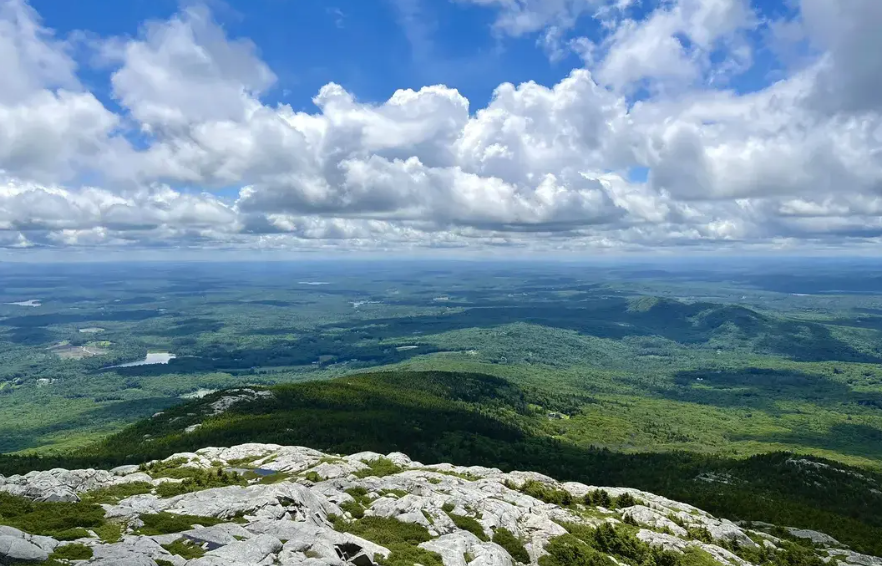
This is what it looks like from up there
The climb to the top of Mount Monadnock is more than 3,000 feet. Up and back down, four hours is enough time. But in all seriousness, it should take longer. Weather permitting, the view from the top is worth sitting up there for a while. The first time I did it, about halfway up I had to ask myself why I was even doing it. It’s a lot of work. A cardio + leg workout that’ll leave you tired for the rest of the night, and even a little sore the next morning. But once I got to the top, I understood that the juice was worth the squeeze – and I’ve been climbing that mountain again and again, for years.
It isn’t easy, and last July I even sprained my MCL on my way down. Mountain climbers tend to have a certain look, and apparel to match. Until recently, the most self-inflicted challenge I’ve seen was a dude who was making the trek wearing Crocs. Bad idea, I thought. There are portions of the climb on which traction is important, and where a fall would be catastrophic. Rangers are there to assist the injured, and I once saw a woman experiencing heat exhaustion. They had to strap her to a board to get her down. I can’t imagine how hard that must have been.
So that father and daughter – they got my attention pretty quickly. I heard the daughter warning her Dad about a rock beneath his next step. She guided his arm to a tree and told him to use it to pull himself to a small, flat piece of land. Then they stopped, and she turned around to take in the view from halfway up. He didn’t turn around, though. He was facing the opposite way, his head seemingly looking up at the sky. Then she started talking about what she saw.
Then I saw it.
He had a cane, and it wasn’t the kind hikers used to keep their balance on uneven land. It was the kind that he had to use to keep himself from walking into things in front of him. Because he was blind. I processed this immediately and was inspired instantaneously. As I passed, I stopped to tell them that while people are inspired by movies and books, there is far more inspiration in what I saw in them. A blind guy and his daughter, climbing a mountain.
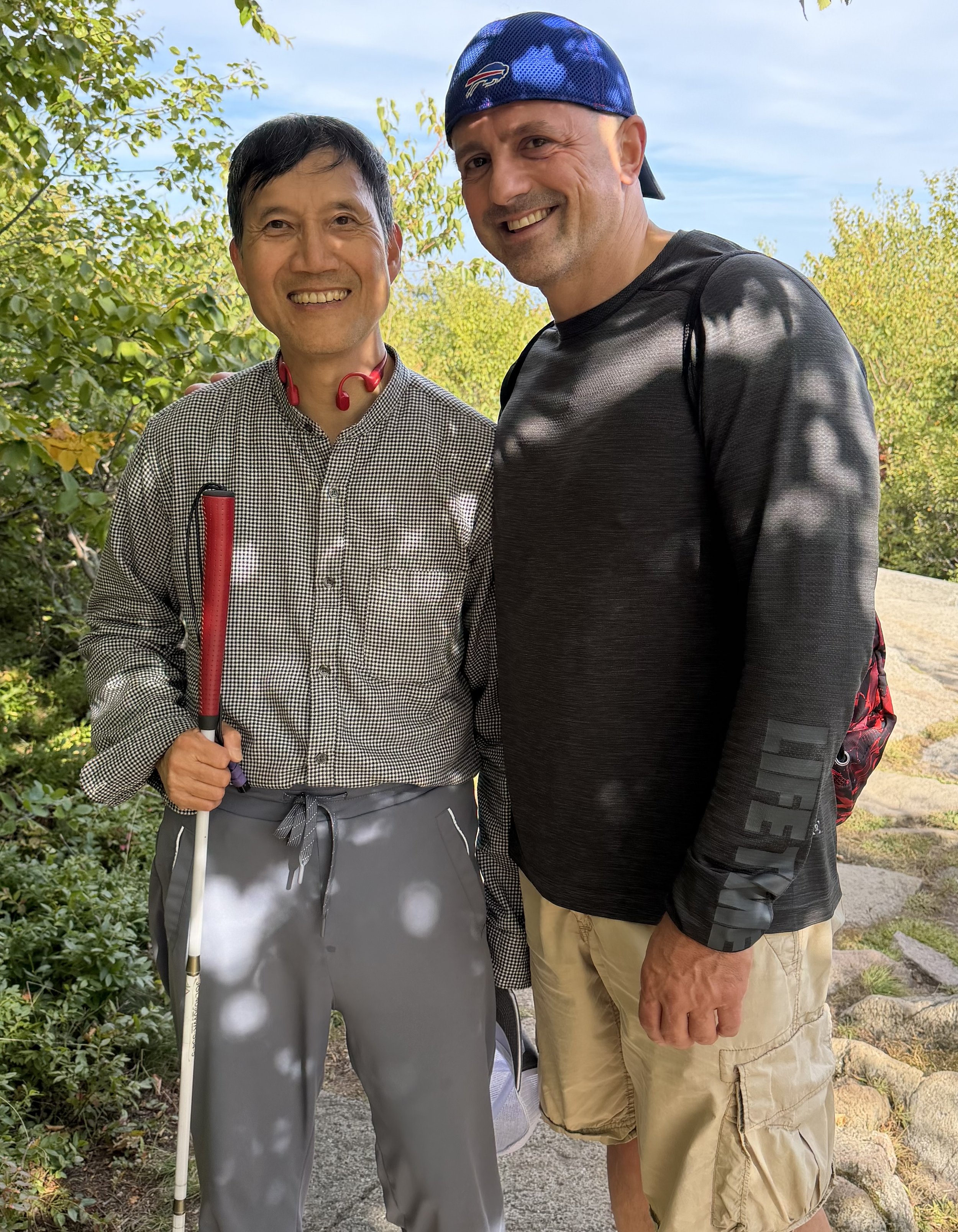
There’s only one word…Inspiring
I got about a hundred feet ahead of them and then turned back to talk to them. You see, Monadnock has several trails. The one we were on was the most challenging. The steepest one. The Dad’s name was Parkson, and his daughter’s name was Bonnie. I learned this wasn’t their first hike, and that he enjoyed it. I explained I was a writer and asked if they’d mind if I wrote about them. They obliged.
For people who can see, climbing a mountain is enticing because the effort to get to the top is worth the reward: seeing what things look like from up there. And in a world where higher education, harder work, and more hours don’t always mean a less stressful, more abundant existence, digging it out to reach the apex is a subtle reminder. Every once in a while, there’s an immediate connection between the effort it takes to do something and the outcomes that come our way.
How much time do you spend dealing with problems that don't resolve cleanly? People, meetings, regulations, politics, parents, personalities – effort doesn't necessarily produce the intended outcome, and sometimes doing everything right still doesn't get you where you believed you’d be. Maybe that’s why I like climbing that mountain. It’s simple. You keep going up, and eventually you get to the top. Your legs hurt, you’re sweating, and more than once you wonder how doing this is a good idea. But you know what’s waiting for you. You reach the top, turn around, and see something you couldn’t see from your office window. There’s a payoff.
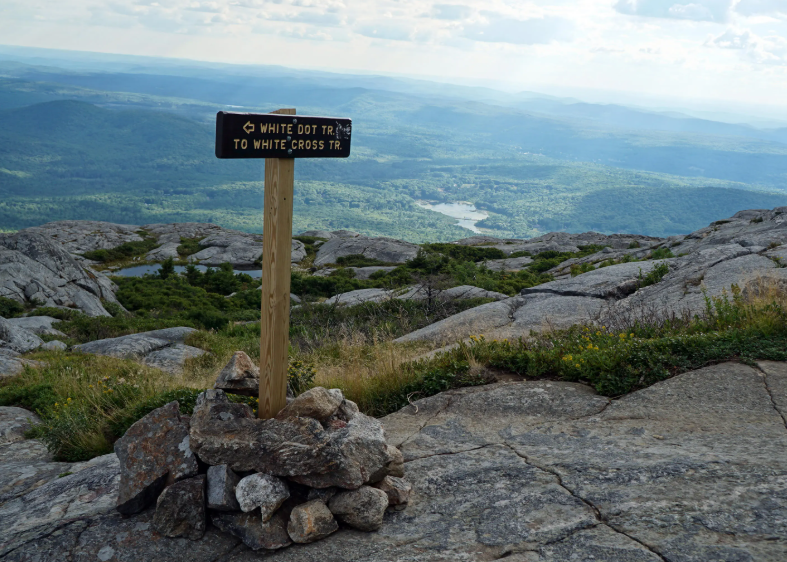
There aren’t many trees at the top because a few hundred years ago, farmers burned the mountain so the wolves would have noplace to live
Except that wasn’t true for Parkson. He wasn’t going to see the view from the top. That occurred to me as I continued climbing, and I couldn’t stop thinking about it. I climb Monadnock because I like the challenge, but the view…that’s the reward. Parkson was doing all the work without ever getting that part. He couldn’t see the next rock, never mind the summit. He had to trust Bonnie when she told him where to put his foot, when to grab a tree, or when the next step was dangerous.
I didn’t miss the irony. I’ve spent much of my career trying to make the world more accessible for people with disabilities. Schools, classrooms, programs, buildings. We work hard to remove barriers so that everyone has a way in. Mount Monadnock is about as far from accessible as a place can be. No ramps go up the side of a mountain. The rocks don’t move out of the way. The steep parts don’t get less steep because someone wants them to. Parkson knew all of that before he got there.
It made some of the things that bother me seem a little smaller. The long line. The annoying email. The five-minute issue that takes twenty. We all have real problems, and someone else having it harder doesn’t make ours disappear. But there is something worth remembering about a blind man choosing to climb a mountain on top of which, he will never see from the top. He knew it would take longer. He knew he would need help. He knew other people would experience parts of it that he never could. None of that stopped him. He wanted to climb a mountain, so he climbed a mountain.
And then there was Bonnie. She wasn’t carrying him, and she couldn’t make the mountain easier. She simply stayed close. She warned him about the rocks. She showed him where to put his foot and what to grab when he needed help. And because he couldn’t see the view, she described it to him.
I thought about my son.
He’s fifteen now, and I’m realizing that being his father is becoming less about clearing the trail in front of him. I won’t always be able to keep him from falling. I won’t choose every mountain he climbs, and there will be rocks I see coming that he won’t. Maybe my job is more like what Bonnie was doing. Stay close. Tell him what I can see. Warn him when I can. Give him something to grab onto when he needs it. And when he can’t see beyond the difficult place where he happens to be standing, remind him that there might be something beautiful ahead.
Then, just let the boy climb.
On my way down Monadnock, I saw Bonnie and Parkson again. They were still on their way up. I don’t know how long it took them to get there, but I’ve been thinking about the two of them standing at the summit. Parkson feeling the wind on his face and the sun on his skin. Bonnie telling him about the trees and the streams below, and how the clouds cast huge shadows across the landscape as they move overhead.
I picture him standing there listening to his daughter describe a view he worked so hard to reach but would only hear about and never see. I see him smiling, and as I type this…I am too. Underdogs inspire me, and knowing there’s a blind man out there climbing a mountain is all I need to keep me climbing too.